While many 80s music videos relied on neon lights and abstract choreography, ‘Til Tuesday’s “Voices Carry” (1985) opted for a “mini-movie” approach. If the video feels more like a psychological thriller than a pop promo, that’s no accident. Director D.J. Webster utilized a toolkit of visual storytelling techniques that are remarkably similar to the work of Alfred Hitchcock, turning a pop song into a “Symphony of Suspense.”
The “Man Who Knew Too Much” Parallel
While the video’s cinematic style is pure Hitchcock, the song’s emotional weight comes from its controversial origins. Read why ‘Voices Carry’ was almost a completely different song here.
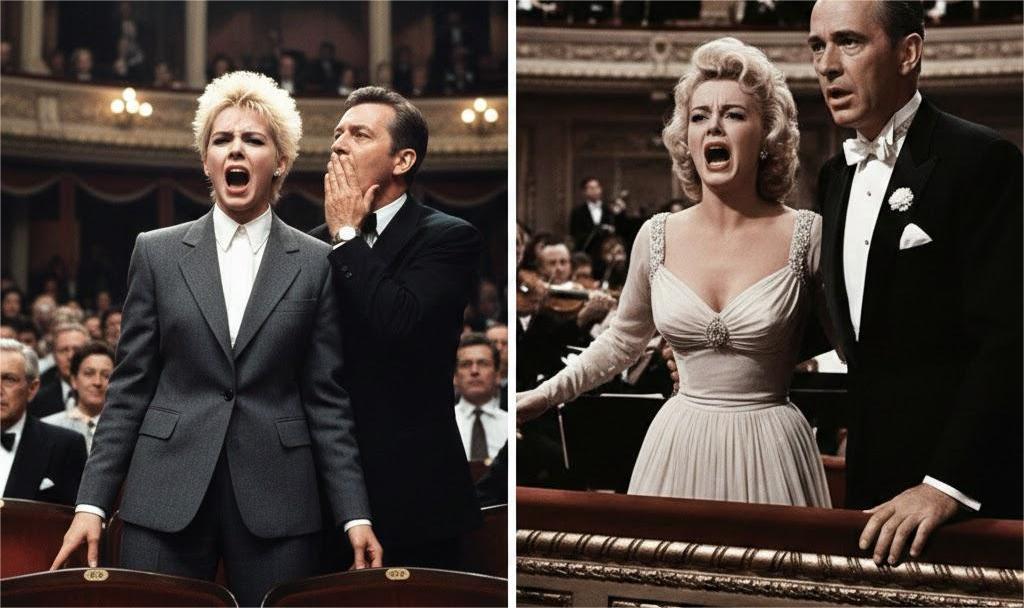
The most striking connection is the video’s climax. Aimee Mann, sporting her iconic bleached rattail hidden under a hat, sits in a formal theater (Boston’s Strand Theatre, doubling for Carnegie Hall). As her abusive boyfriend shushes her, she stands up and screams the lyrics.
This is a direct narrative echo of the 1956 Hitchcock classic, The Man Who Knew Too Much. In that film’s climax at the Royal Albert Hall, the protagonist (Doris Day) must let out a scream at the moment of a crashing cymbal to thwart an assassination plot. In both the film and the music video, a woman uses her voice as a weapon to disrupt a high-society event and break a cycle of control.
The “Hitchcockian” Visual Language
Beyond the plot, the video uses specific cinematography tropes that define the “Master of Suspense”:
- The Voyeuristic Gaze: Throughout the video, we see the boyfriend (Cully Holland) watching Aimee through doorways or across rooms. This mirrors the voyeurism found in Rear Window, where the act of “looking” becomes a tool of power.
- The “Hush” Motif: Hitchcock was a master of using silent gestures to build tension. The recurring “shushing” finger in the video is used as a visual “MacGuffin”—a simple object or gesture that drives the psychological dread of the narrative.
- The Transformation of the Blonde: Hitchcock famously preferred “cool blondes” whose outer composure hid inner turmoil. Aimee Mann’s character fits this archetype perfectly: the “respectable” woman in the suit who eventually “cracks” to reveal her radical, true self.
Why the Comparison Still Ranks in 2026
Film students and 80s enthusiasts have long debated whether these links were intentional or subconscious. Regardless of the director’s official stance, the thematic alignment is undeniable. In the same way Hitchcock’s films explored the “gaslighting” of women long before the term was common, “Voices Carry” remains a visual masterpiece about the explosive power of a woman who refuses to be hushed.
The theater scream wasn’t just a movie reference; it was the moment Aimee Mann finally found her voice. Revisit our original breakdown: Why you still need to listen to ‘Voices Carry’ 30+ years later.